1. Industrial Criticality & Unpredictable Power Collapse Symptoms
In high-density manufacturing automation architectures, Allen-Bradley / Rockwell Automation ControlLogix 1756 chassis power supplies—including the 1756-PA72, 1756-PA75, 1756-PB72, and 1756-PB75 modules—serve as the critical electrical backbone feeding multi-axis motion controllers, high-speed EtherNet/IP communications bridge cards, and discrete I/O racks. When these power modules experience internal degradation, plant engineers frequently observe unexpected CPU fault trips, intermittent backplane communication drops, and system shutdowns during heavy machine indexing. For industrial facilities requiring Rockwell ControlLogix 1756 power supply repair and PLC chassis and I/O module restoration, Apex Industrial Control provides component-level bench diagnostics to isolate root-cause failures and reduce unscheduled downtime.
2. Thermal Cycling Stress & Lead-Free Solder Joint Fatigue
Operating 24/7/365 inside sealed, unventilated NEMA industrial enclosures subjects ControlLogix power supplies to severe internal thermal stress. The high current throughput handled by main switching transformer pins, primary power MOSFETs, and output filter chokes generates intense local heat pockets. Over thousands of operational hours, continuous thermal cycling creates physical expansion and contraction differentials between component leads and the multi-layer FR4 circuit board. This thermal fatigue causes microscopic grain structure separation within lead-free solder alloys, leading to hair-thin ring cracks, cold solder joints, and intermittent micro-arcing that degrades DC voltage regulation.
3. High-Magnification Stereo Optical Inspection Protocol
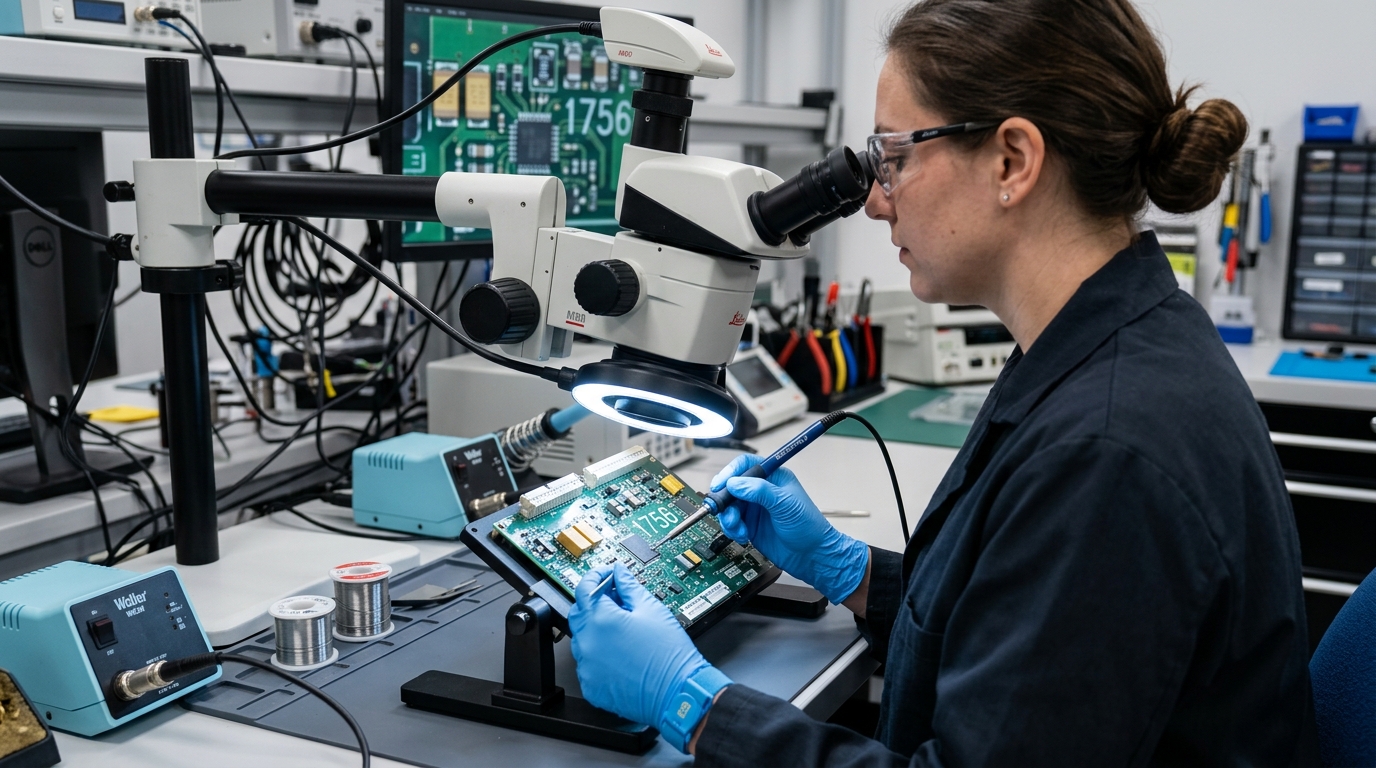
Standard visual inspection with the naked eye is completely inadequate for diagnosing modern high-density switch-mode power supplies. In the specialized micro-electronics laboratory at Apex Industrial Control, technicians inspect every incoming 1756 power module under precision industrial stereo optical microscopes under high-intensity ring lighting. This optical protocol reveals sub-millimeter annular solder cracks around heavy transformer pins, microscopic through-hole via wall fractures, charred SMD current-sense resistors, and subtle dielectric breakdown signs across optical feedback isolators.
4. Micro-Soldering Rework, Low-ESR Capacitor Replacement & Conformal Sealing
Once failure points are isolated, Apex Industrial Control engineers perform component-level restoration at an ESD-controlled rework bench. Utilizing temperature-controlled micro-soldering stations and high-reliability solder alloys, cracked high-current joints are reflowed and reinforced. Aging electrolytic capacitors subject to electrolyte dry-out are replaced with 105°C low-ESR industrial-grade capacitors. Following soldering rework, the PCB undergoes an ultrasonic cleaning process to remove flux residues, followed by the application of an industrial polyurethane conformal coating to help protect circuitry against moisture, oil mist, and airborne contaminants.
5. Simulated Chassis Load Testing & Digital Oscilloscope Ripple Validation
Testing a repaired power supply on a bench without an electrical load can be misleading, as degraded components often output nominal voltages under zero load but sag when current demand increases. At Apex Industrial Control, every overhauled 1756-PA75 and 1756-PB75 module is installed into a simulated ControlLogix test chassis equipped with active load banks representing CPU, motion, and I/O current draw. Using digital storage oscilloscopes, engineers monitor the 24VDC, 5VDC, 3.3VDC, and 1.2VDC power rails, verifying that peak-to-peak voltage ripple and high-frequency switching noise remain within operational DC bus regulation limits across all active backplane rails.
6. 24-48 Hour Emergency Rush Turnaround & Comprehensive 12-Month Warranty
To minimize catastrophic production losses when an active ControlLogix rack suffers power loss, Apex Industrial Control offers an expedited 24-to-48 hour emergency rush repair service (Rush Service). Every remanufactured 1756 power module leaving our Virginia facility is backed by a comprehensive 12-Month In-Service Operational Warranty, giving manufacturing operations complete confidence in long-term hardware reliability.